The AuDHD Test in a Cartoon: Psychometrics and Epistemic Agency
"I made the audhd test I needed decades ago. I wanted to be taken seriously, so I based it on psychometrically valid empirical measures... and then I put it in a cartoon."
I went through six jobs in twenty years. Throughout school and every performance review that followed, managers handed me the exact same sentence: "You have so much potential."
Cool. So does uranium.
I was diagnosed in the middle of a complete breakdown. I lost my dad, my relationship, and my job in the exact same stretch. Sitting there in the aftermath, finally looking at the diagnostic paperwork, my first thought was simple: that would have been useful information at any point before now.
Everyone kept handing me planners. I have an entire drawer of them at home. They are sitting in there right now, silently judging me. That was never the fix.
Nothing is wrong with you; you were handed the wrong manual. I write the right one, with you or for you.
When we set out to build the screening engine at ADHD Works This Way, I knew exactly what I refused to build. I refused to build another sterile clinical intake form that makes people feel like criminal defendants. And I refused to build another personality quiz that spits out horoscopes and demands your email address.
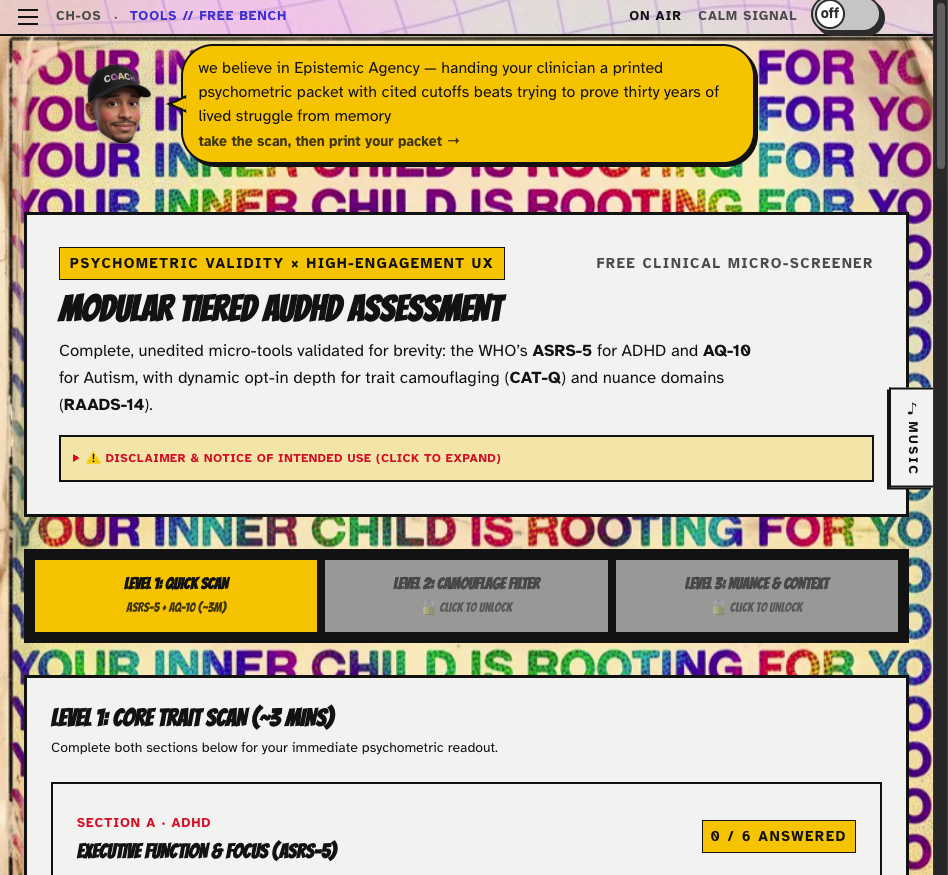
We took validated clinical instruments and placed them inside a retro Saturday-morning comic book. Here is why the science and the cartoon belong together.
The Pre-2013 Diagnostic Trap
To understand why adult screening remains broken, look at psychiatric history.
For decades, the official diagnostic manual enforced an exclusionary rule. Under the American Psychiatric Association DSM-IV, maintained until 2013, clinicians were forbidden from diagnosing both Autism and ADHD in the exact same person.
[ PRE-2013 DSM-IV PARADOX ]
                 Diagnostic Fork
                        |
                +-------+-------+
                |               |
          [ AUTISM ]       [ ADHD ]
          (Excluded ADHD) (Excluded Autism)
If a clinician diagnosed autism, your working memory drops and task paralysis were dismissed as secondary traits. If you were diagnosed with ADHD, your sensory overload and intense hyperfocus were labeled distractibility.
It was only in May 2013, with the publication of DSM-5, that medicine caught up to what people had lived through for generations. ADHD and autism frequently coexist:
- Between 50% and 70% of autistic individuals meet diagnostic criteria for co-occurring ADHD.
- Between 20% and 50% of adults diagnosed with ADHD display clinically significant autistic traits.
Because clinical practice lags research, an entire generation grew up trapped in that gap. The average age of diagnosis for high-masking adults falls between 30 and 42 years old. That is decades of misattribution, cycling through labels for depression or anxiety before anyone evaluates the real pattern.
The Three Validated Instruments
When I studied community psychology at Georgia State and worked in clinical research with the Grady Trauma Project, I learned what actually holds weight with clinicians. You do not show up with an internet quiz. You show up with validated instruments.
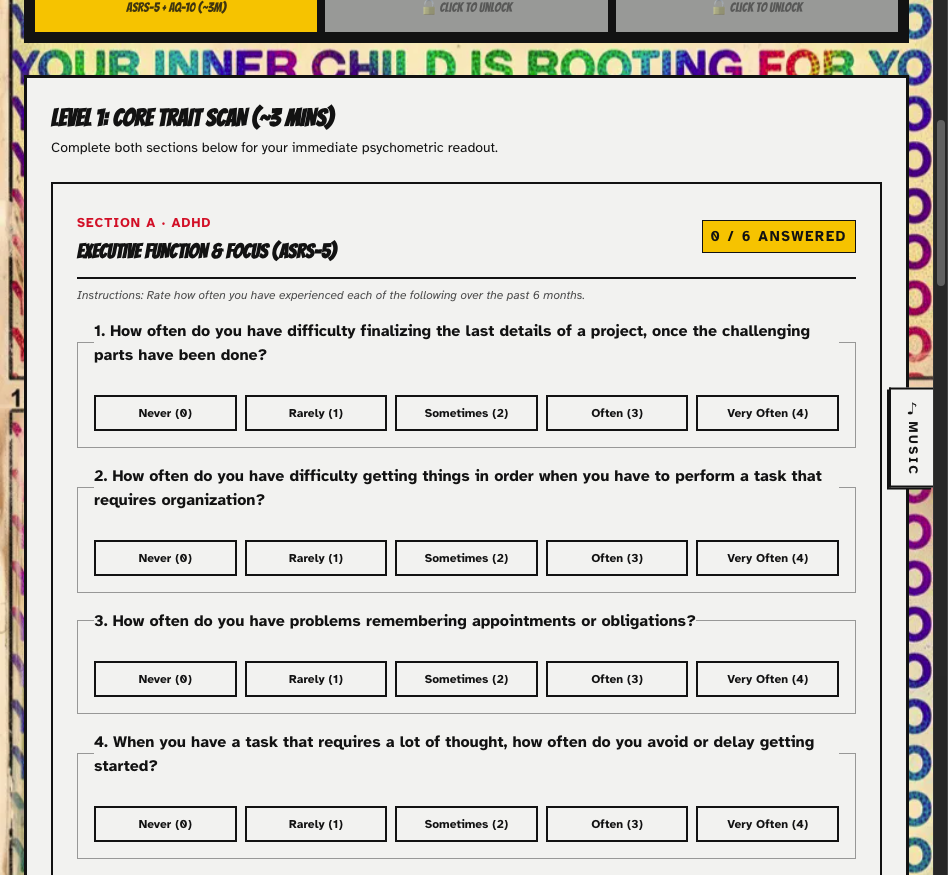
The Modular Tiered AuDHD Assessment uses three open-access instruments in a structured cascade:
| Tier | Instrument | Primary Reference | Threshold |
|---|---|---|---|
| Level 1A | WHO ASRS-5 | Ustun et al., 2017 (JAMA Psychiatry) | Score >= 14 (91.4% Sensitivity, 96.0% Specificity) |
| Level 1B | AQ-10 | Baron-Cohen et al., 2011 (JAACAP) | Score >= 6 (Significant Autistic Traits) |
| Level 2 | CAT-Q | Hull et al., 2019 (JADD) | Score >= 100 (Clinically Elevated Camouflaging) |
1. Level 1A: The WHO ASRS-5 for ADHD
In 2017, Bilgehan Ustun and colleagues at Harvard Medical School and the World Health Organization published a milestone study in JAMA Psychiatry. Using machine learning across clinical datasets, they isolated the six questions with the highest discriminative power for adult ADHD.
Calibrated to DSM-5 criteria, a score of 14 or higher out of 24 yields 91.4% sensitivity and 96.0% specificity. It evaluates organizational friction, task initiation hesitation, memory drift, and restlessness in two minutes.
2. Level 1B: The AQ-10 for Autism
Developed by Sir Simon Baron-Cohen and the Autism Research Centre at the University of Cambridge, the AQ-10 isolates core vectors: attentional switching friction, detail focus, and social communication reading. A score of 6 or higher out of 10 signals that formal exploration is warranted.
3. Level 2: The CAT-Q Camouflaging Filter
This is where traditional screening fails late-diagnosed adults: masking.
In 2019, Laura Hull and her team published the Camouflaging Autistic Traits Questionnaire in the Journal of Autism and Developmental Disorders. The instrument measures three compensation strategies:
- Compensation: Explicit cognitive tactics to handle social communication, such as scripting conversations.
- Masking: Efforts to hide characteristics, such as forcing eye contact or policing body posture.
- Assimilation: Performing an unnatural persona to blend into social environments.
A total score of 100 or higher indicates severe camouflaging. When someone scores high on ADHD but sits borderline on autism, the engine opens Level 2. In high-masking professionals, compensation suppresses overt behavioral markers until physical burnout forces a collapse.
Adult Diagnostic Facts
The obstacles to adult evaluation are structural:
- Financial Gatekeeping: In the United States, private adult neuropsychological assessments cost between $2,500 and $5,000 out of pocket. Insurance coverage for adult developmental evaluations remains rare.
- Waitlist Latency: Specialized clinics have waitlists averaging 9 to 18 months, leaving people stuck without accommodations while workplace friction builds.
- The Masking Gap: Diagnostic criteria were originally normed on young boys displaying disruptive classroom behavior. Adults who internalize struggle are routinely missed until middle age.
- Employment Friction: Neurodivergent degree holders experience underemployment rates of 30% to 40%, driven by interview masking exhaustion and rigid corporate environments.
Why Put Validated Science in a Comic Strip?
When you walk into a clinical evaluation, your body reacts like it is being interrogated. If you have spent decades being told you are lazy or dramatic, walking into a medical office spikes stress immediately. You sit up straight, smile, downplay your struggles, and accidentally talk yourself out of an accurate assessment.
Putting the screener inside a comic book layout changes that response:
[ STERILE CLINICAL INTAKE ]          [ NEUROAFFIRMING COMIC UX ]
            High Stress Interrogation           Playful Exploratory Framing
                        |                                    |
                  Spiked Stress                     Limbic De-escalation
                        |                                    |
                 Defensive Masking                  Honest Self-Disclosure
                        |                                    |
               Distorted Assessment                  Accurate Baseline
Halftone textures, primary colors, and speech bubbles tell your stress response that this is not an interrogation. It turns a grueling clinical evaluation into a low-pressure scan.
Most online quizzes are data-harvesting funnels that lock your results behind an email capture, then flood your inbox with marketing.
The screener on adhdworksthisway.com runs entirely in your browser:
- Zero email gates.
- Zero trackers or data storage.
- Immediate visual score readout.
- A single-click "Print Clinician Export" button.
That is epistemic agency. Showing up to your doctor or therapist with printed psychometric documentation citing JAMA Psychiatry and Cambridge cutoffs gives you data to point at, instead of having to defend your entire life from memory in fifty minutes.
Run the Scan
If your focus struggles never fit standard advice, or if an ADHD diagnosis never explained your sensory fatigue, test the screener yourself.
Run the free scan on our sister network: Modular Tiered AuDHD Assessment at ADHD Works This Way ->